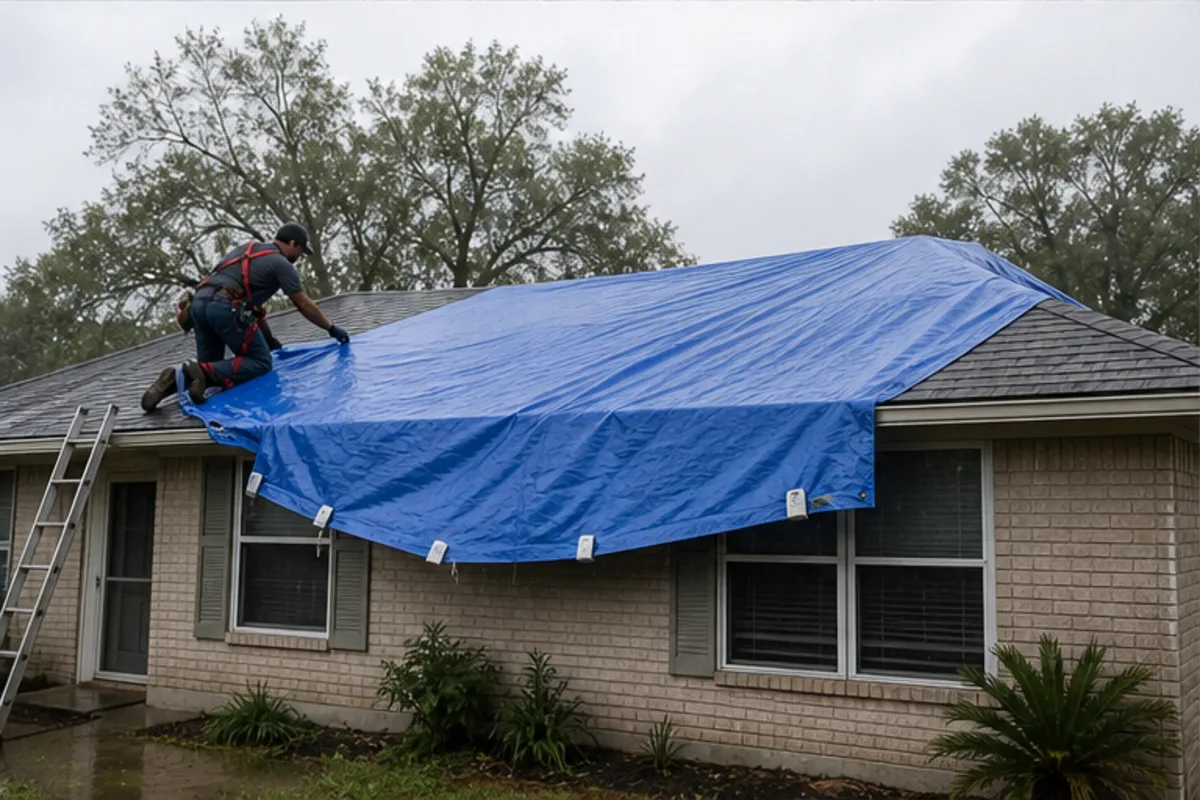
Emergency Roof Tarping Houston Condition Record for Houston Properties
Temporary weather protection defined by safe access, securement method, coverage limits, and follow-up repair. The first objective is to identify the exact roof area, material, transition, interior consequence, and timing connected to the request. A broad description such as “the roof leaks” is converted into a roof-plane location, a room reference, recent weather context, and an access plan.
The condition record distinguishes observation from assumption. Visible displacement, staining, corrosion, surface wear, ponding, soft decking, or failed sealant is photographed as found. Probable causes remain clearly identified as probable until access, removal, or testing supports a more specific conclusion.
Emergency Roof Tarping Houston Inspection Scope and Safe Access
The inspection concentrates on active openings, exposed deck, displaced covering, vulnerable ridges, and safe anchor points. Roof access is assessed before work begins, and inaccessible or unsafe areas are documented rather than represented as inspected. Interior, attic, perimeter, aerial, and roof-surface observations are combined only when those views are available.
Emergency Roof Tarping Houston Photo and Measurement Evidence
The working file can include pre-cover photographs, tarp boundary, attachment record, interior risk notes, and next-step scope. Wide photographs orient the reviewer; medium views connect the condition to adjacent details; close images show the material interface. Measurements and quantities are used where they affect removal, replacement, access, or pricing.
Emergency Roof Tarping Houston Repair, Replacement, and Monitoring Decision
The working decision is to use temporary protection only as a bridge to a documented permanent repair. Repair remains a controlled option when the defect can be isolated, surrounding materials can tolerate the work, and connected details can be restored. Replacement becomes relevant when continuity, repeated failures, widespread wear, or concealed-condition risk makes another patch difficult to define.
| Path | Suitable condition | Required record |
|---|---|---|
| Repair | Bounded defect with workable surrounding material | Removal limit, components, compatibility, verification |
| Replace | System-level deterioration or repeated disconnected repairs | Assembly schedule, deck allowance, staging, closeout |
| Monitor | Serviceable condition without active consequence | Photo baseline, priority, trigger, review date |
Emergency Roof Tarping Houston Work Control and Property Protection
Before authorization, the written scope should identify roof areas, access, removal, new materials, connected accessories, property protection, weather staging, debris handling, concealed-condition allowances, and the method used to approve changes. Occupied interiors and active businesses require named communication contacts and affected-area notices.
Completion documentation should mirror the starting record. Final photographs show the repaired or installed details from enough distance to locate them and close enough to review them. Open items, monitoring points, owner maintenance responsibilities, and exclusions remain visible in the handoff rather than disappearing from the final conversation.
Request Emergency Roof Tarping Houston Service in Houston
Send the Houston ZIP code, property type, roof type if known, visible concern, active interior water status, access notes, and optional photographs. The address and service fit are confirmed before scheduling.